Detect
Optical sensing measures how the material absorbs IR and UV light. Pulling a signal from substrates so dark they hide it from everything else.
Embedded Systems Engineering
We do portable identification and traceability using our technology that reads where light is invisible, bringing certainty to the darkest, hardest-to-measure materials.
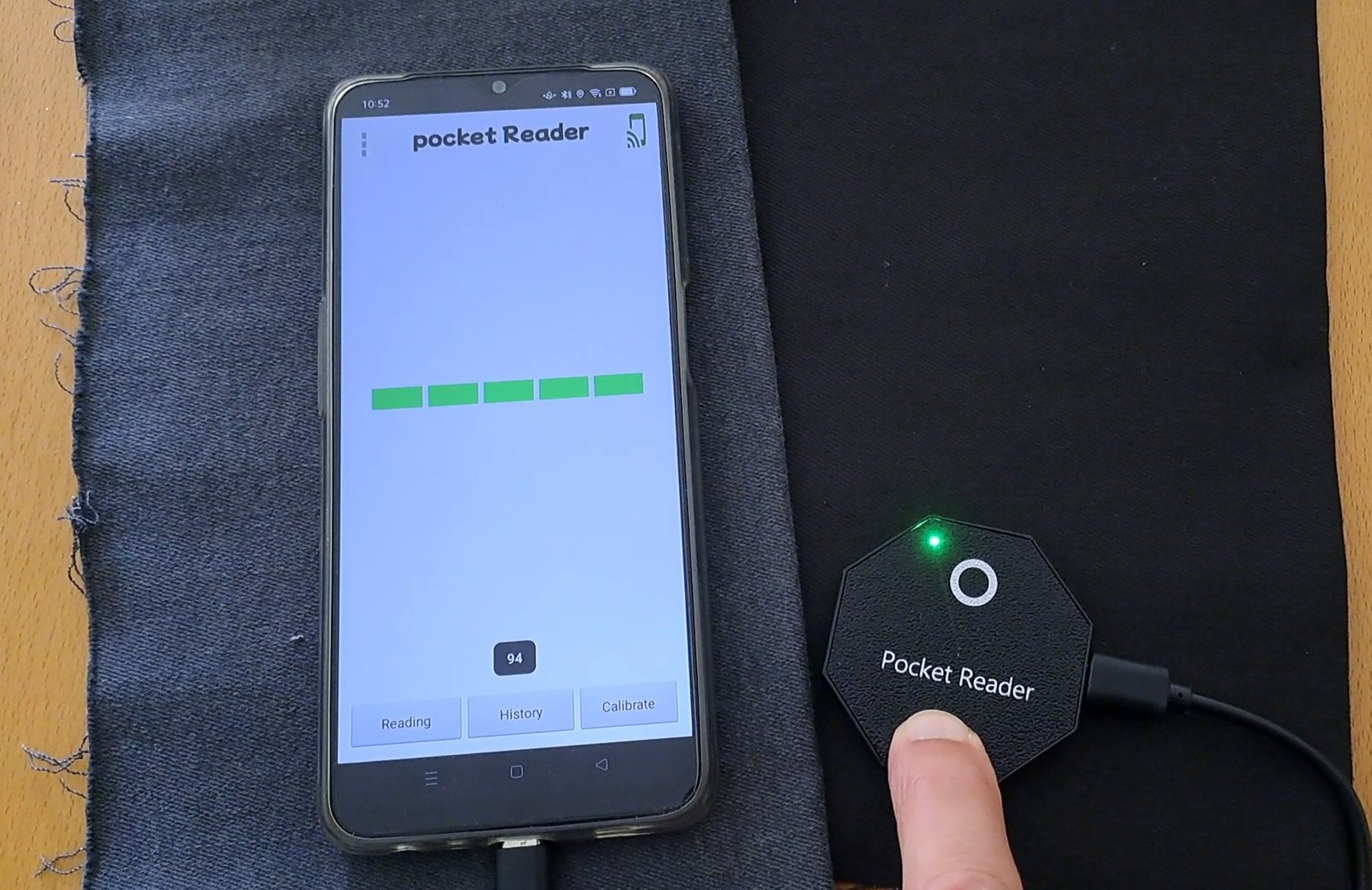 Pocket Reader
The Product
The Pocket Reader is a small, lightweight portable device for identification and traceability, purpose-built for low-concentration detection in materials that defeat ordinary readers.
Sees through carbon black, sulphur and indigo dyes that absorb the light other readers rely on.
Tuned to surface the faintest signal, detecting and quantifying markers at dilutions as low as 1 ppm.
A reflective spectrometer measuring near-infrared and ultraviolet absorption across 900–1100 nm, linking pigment to the darkness of the substrate.
Works on its own or paired with the companion Android app for live readings, history and calibration.
The Technology
Every reading passes through the same disciplined sequence. It is how a faint trace of pigment on a dark surface becomes a decision you can trust.
Optical sensing measures how the material absorbs IR and UV light. Pulling a signal from substrates so dark they hide it from everything else.
The absorption fingerprint is matched against known markers, linking pigment to substrate to reveal exactly what and how much is present.
A confident verdict of genuine or not, traceable, repeatable, and delivered in the field, whether the device stands alone or reports to the app.
Specifications
A near-infrared and ultraviolet reflective spectrometer, engineered in Aveiro and CE-certified: here is what it reads, how faint a trace it catches, and how it connects.
Features marked “coming soon” are in development; specifications may change.
Services
Beyond our own products, we work with clients across the full embedded stack, from the first electronic component to production-ready hardware, firmware and software.
Support from electronic component selection through to pre- and post-production, engineered for manufacture from day one.
Built on years of developing the software and firmware behind our own products, offered as consultancy across a range of areas.
FAQ
The essentials on the Pocket Reader, our DIA method and how we work.
The Pocket Reader is a small, lightweight portable device for identification and traceability, purpose-built for low-concentration detection in materials that defeat ordinary readers. It works stand-alone or paired with a companion Android app for live readings, history and calibration.
It reads dark, light-absorbing substrates that defeat ordinary optical readers, including carbon black and sulphur black, plus the inks, varnishes and coatings that carry taggant markers. Using near-infrared (NIR) and ultraviolet (UV) reflective spectroscopy across the 900–1100 nm range, it detects and quantifies markers at dilutions as low as 1 ppm.
DIA stands for Detect, Identify, Authenticate: the three-step sequence every reading follows. Optical sensing detects how a material absorbs IR and UV light, the absorption fingerprint is matched against known markers to identify what is present, and the result is a repeatable, traceable verdict of genuine or not.
No. It works on its own, or paired with the companion Android app for live readings, history and calibration.
Yes. We work across the full embedded stack: hardware development from component selection through to production-ready boards, and software and firmware consultancy including embedded firmware, Android and mobile software, and architecture and R&D consulting.
Use the quote form on this page with your application and requirements, and our team will review them and get back to you with a tailored quote.
Quote
Please provide your details below. Our team will review your requirements and get in touch to discuss a tailored solution.
Contact
Tell us about the material, the marker or the traceability problem you're facing.
SPIN & TURN, LDA
Mirador Business Center
Av. Europa 702
3800-012 Aveiro, Portugal